
シェクスピア作品における嫉妬 (Jealousy in the works of Shakespeare)
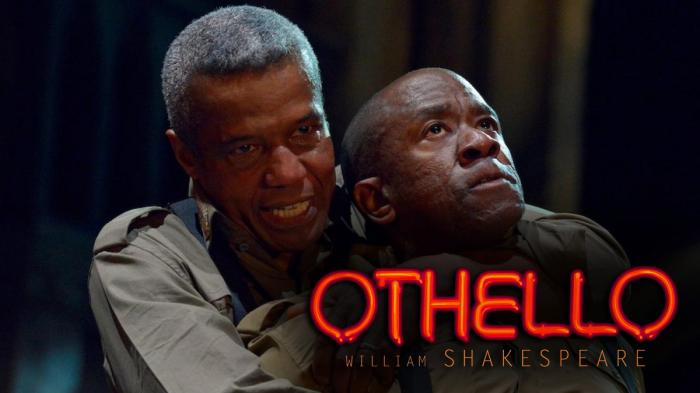
Royal Shakespeare Company の「オセロ」上演 Digital Theater より
1564 年から 1616 年まで生存したシェクスピアは、人間の様々な感情を作品の中で扱っているが、彼が嫉妬についてどのように描いているか見ていきたいと思います。シェイクスピアが、嫉妬について深く掘り下げた作品は、1604 年に書かれたとされる『オセロ』(Othello) と 1610 年頃に書かれたとされる『冬物語』(The Winter's Tale)です。『オセロ』は有名な作品であり、ほとんどの人が聞いたり、本で読んだりしているのではないかと思いますが、『冬物語』のほうは知っている人は少ないでしょう。サッポロビールが、冬の限定版として、「冬物語」という銘柄のビールを売り出していますが、もちろん、シェイクスピア作品の題名から取ったものであることは、言うまでもないでしょう。
「嫉妬」という感情
それはさておき、嫉妬とはどのような感情であろうか。小学館の『国語大辞典』をひくと、「自分よりすぐれたものをうらやんだり、ねたんだりする気持ち」あるいは「自分の愛する者の心が他に向くのをうらみ憎むこと」と書いてあります。もう少し抽象的な言葉で言えば、自分のものであると思っていたものが、他人に勝手に使用されたことから引き起こされる感情とも言えます。シェイクスピアは作品『オセロ』の中で、嫉妬のことを「青い目を持った怪物」 (Gree-eyed monster) と形容していますが、嫉妬の恐ろしい性格をよく表現していると思われます。
オセロの嫉妬
オセロがデズデモーナ (Desdemona) に嫉妬するのは、彼女の愛情が副官であるキャシオー (Cassio) に移ったと、オセロが思ったからであり、もちろんイアゴー (Iago) がその時に重要な働きをします。『冬物語』の主人公であるレオンティーズ (Leontes) が嫉妬を感じるのは、彼の妻であるハーマイオニー (Hermione) が、友人のポリクシニーズ (Polixenes) を好きになり、彼を殺してシシリーの王位を奪おうとしていると邪推したからであります。一方は部下と妻、一方は友人と妻という身近な人間に嫉妬を感じることが多いようです。夏目漱石の『こころ』も、友人間の嫉妬を扱っており、古来より友人と一人の女性を奪い合うというケースは多いようです。夏目漱石の『行人』はあろうことか、兄の長野一郎が、弟の長野二郎を自分の妻が愛しているのではないかと思い、嫉妬に狂います。
家父長制
それでは、最初に『オセロ』において嫉妬がどのように描かれているか見てみましょう。デズデモーナの父親であるブラバンショー (Brabantio) は、自分の娘と勝手に結婚したオセロに向かって、” Look to her, Moor, have a quick eye to see:/ She has deceiv’d her father, and may do thee.” (I.iii.292-3) 「ムーア人よ、彼女には気をつけろ、人を見抜く鋭敏な目を持て。父親を騙したのだからお前も騙しかねない」と、予言とも忠告とも取れるせりふを言います。彼の言葉は、おそらくオセロの無意識に眠っていた思考を、言い表したもので、女性は男性の信頼を裏切るものだという考えが、男性の無意識には刻印されているようです。男性は浮気のしほうだいで、女性が浮気をすると罰せられるのは、今日の男女同権時代には合わない考えですが、シェイクスピアが活躍していたエリザベス朝やジェイムズ朝時代は、当たり前の思考方法でした。それは家父長制が当時の一般的な考えであり、男性中心の時代であったからです。家父長制で一番大切なことは、正当な子孫を残すことで、それには女性の貞潔が重要になります。
このような家父長制の考えに縛られて、オセロも行動しているので、彼がデズデモーナに貞潔を求めるのは、当然の成りゆきでしょう。家父長制が女性の貞潔に依存しながら、その基礎がかなり危ういということは、次の Marilyn L. Williamson の言葉からも察せられます。 (The Patriarchy of Shakespeare's Comedies -Wayne State U. P., 1986)
The nightmare of the patriarchy’s dependence on creating female nature is that the unchaste wife will bear false generations because we live on a bawdy planet.
家父長制は、女性の貞潔という幻想に、しがみついている男性側の妄想かもしれません。
ムーア人という立場
それからもう一つ、オセロがデズデモーナに対して嫉妬を感じる原因を持っています。それは彼がムーア人、今日で言えば、黒人であったと言うことです。今でこそ人種差別など非難されていますが、当時のエリザベス朝では、肌の色の違いは決定的な人種差別を引き起こす要因でした。おそらく当時の観客は、白人であるデズデモーナと黒人であるオセロが結婚したという事実に、当惑したことでありましょう。しかもデズデモーナは、ベニス公国の元老院の娘であり、いかにオセロが武勇にすぐれていると言っても、彼の相手としてデズデモーナは不釣り合いと考えれることが多いでしょう。それだからこそ、ある登場人物は、オセロが魔法を使って、デズデモーナを誘惑したと思ったのです。オセロの嫉妬が誘発される原因は、家父長制と彼の肌の色からくる劣等感です。イアゴーがいかに弁舌に優れていようと、これらの誘発原因がなければ、あれほどやすやすと、デズデモーナの不倫を、オセロに信じ込ませることは出来なかったでしょう。
部外者の立場
それともう一つ重要な側面は、家父長制はヨーロッパ文明の思考形態であり、ムーア人であるオセロとは一見関係ないと思われるが、その文明に部外者 (stranger) であるからこそ、なお一層その文明が醸し出す雰囲気に、馴染もうとする傾向があるようです。日本でも外人の方が、日本人以上に日本のことを知り、日本の文化を吸収しようとしていることがあります。オセロもベニス公国の基本的な考えである家父長制に、内部の人間以上に過剰反応したとしても、珍しいことではないでしょう。"stranger" という言葉は、日本語に直せば、「他者」という意味で、どのように努力しても、内部には入り込めない人間のことを指しますが、この境界線上でオセロは、心情的にいらいらしていたはずです。
これだけの要因があったからこそ、たった一枚のハンカチで、イアゴーはオセロを疑心暗鬼の固まりにすることができたのです。おそらく皆さんは、現実にはそんなことが起きるはずはないと、思っているかもしれませんが、思いこみというのは激しいもので、オセロのことを笑えなくなります。「人間は見たいものを見る」と心理学では言っていますが、自分の考えに合うような現実を、人間は見ているものです。反対から言えば、自分の思考に合わない現実は、無視することを人間は平気でしているのです。オセロはデズデモーナが自分のような黒人を真剣に愛するはずはないと思っているからこそ、イアゴーの策略にまんまとはまったわけです。「目に見える証拠」をオセロはイアゴーに要求しますが、本当のところは、「目に見える証拠」などどうでもよかったのかも知れません。彼は自分の心の中に思いこんでいることを、思いこみたかったようです。
絞殺は言語能力の圧殺
オセロはデズデモーナが浮気をしていると完全に思いこみ、彼女を殺そうとします。彼の口実は、「これ以上デズデモーナが男を騙さないように」というものです。この彼の言葉こそ、家父長制の思考形態そのものです。社会の安全を確保するためには、デズデモーナを殺さなければならないと、彼は思いこみます。そして彼が妻を殺すのは、寝室の場面です。ここでも当時の観客は戸惑いを感じたはずです。黒人が白人の、それも身分の高い女性を首を絞めて殺しているのですから、観客に複雑な反応を引き起こさないはずはありません。人種差別意識の強い観客であれば、なおさらオセロに対する反発は強かったはずです。ここで注意すべきことは、オセロが首を絞めてデズデモーナを殺すことです。首を絞めるということは、女性の言語活動を奪う象徴的な行為です。彼が信奉している家父長制では、女性の言語能力が、一番扱いにくいものであり、そのために彼はデズデモーナの首を絞めることによって、女性の持つ言語能力を圧殺したかったようです。
『冬物語』の嫉妬
次に『冬物語』における嫉妬について考えてみましょう。主人公のレオンティーズは妻のハーマイオニーが友人のポリクシニーズを愛しているのではないかと思い、嫉妬に苦しみます。そこで彼は忠実な家臣であるカミロにポリクシニーズを殺すように頼みますが、カミロはその命令を実行しません。カミロ (Camillo) はポリクシニーズと一緒にボヘミアに行ってしまいます。レオンティーズはあとに残ったハーマイオニーを裁判にかけて殺そうとしますが、アポロの神託がハーマイオニーは罪がないと断定したので、やっと彼女の無実を信じるようになりますが、その時ハーマイオニーは心労のために死んでしまいます。実は本当は死んでいなくて、最後に復活することになっています。『冬物語』の嫉妬と『オセロ』の嫉妬との違いは、レオンティーズの嫉妬には、王位継承の問題が絡んで、オセロの嫉妬よりも複雑になっていることです。言い換えれば、オセロの嫉妬は人種問題も絡んできますが、単なる男と女の愛憎のもつれと言えますが、レオンティーズは王位継承という問題のため、彼の嫉妬は複雑な様相を取るようになります。Derek Cohen ("Patriarchy and Jealousy in Othello and The Winter's Tale", Modern Literary Quarterly 48, 1987) という批評家は、オセロの嫉妬は論理的で、レオンティーズのそれは感情的だと論じております。
感情と論理
しかし、一概にそうとは言えないのではないかと、私は思います。人間は感情的になればなるほど、論理で感情を押さえつけ、その感情をコントロールしようとするようです。オセロの論理といっても、「これ以上デズデモーナが他の男を欺かない」ために殺すというもので、これはとても論理的とは言えません。私の考えでは、オセロとレオンティーズは、どちらも感情的だと思います。レオンティーズの嫉妬が、オセロの嫉妬よりも感情的だと、D. コーヘンが考えたのは、『冬物語』の言語構造に原因があるのかもしれません。ハーマイオニーの罪が実際に本当かどうかということが、レオンティーズにも観客にも曖昧にされているかぎり、レオンティーズの論理が介入する余地はまったくなく、ただ感情的にハーマイオニーや周囲に対処するしか方法がなかったようです。オセロとレオンティーズの嫉妬の違いは、王位継承という政治的な問題が入り込んでいるかどうかということで、感情的という尺度では、その違いを計ることはできないでしょう。
(English)
Shakespeare, who lived from 1564 to 1616, treats a wide range of human emotions in his works, and here I would like to examine how he depicts jealousy. The two plays in which Shakespeare explores jealousy most profoundly are Othello (written around 1604) and The Winter’s Tale (written around 1610). Othello is a well-known play—most people have heard of it or read it at some point—but The Winter’s Tale is far less familiar. Sapporo Brewery sells a winter-seasonal beer called "Fuyu Monogatari" (“Winter’s Tale”), and needless to say, the name is taken from Shakespeare’s play.
The Emotion of Jealousy
Setting that aside, what kind of emotion is jealousy? According to "Shōgakukan’s Kokugo Daijiten", it is defined as “the feeling of envying or resenting someone superior to oneself” or “resenting and hating the fact that the one you love turns their affection toward someone else.” Put in more abstract terms, jealousy can be described as the emotion that arises when something one believes to be one’s own is freely used by another person. In Othello, Shakespeare refers to jealousy as the “green-eyed monster,” a phrase that vividly captures the terrifying nature of jealousy.
Othello’s Jealousy
Othello becomes jealous of Desdemona because he believes that her love has shifted to Cassio, his lieutenant, and of course, Iago plays a crucial role in fostering this belief. Leontes, the protagonist of The Winter’s Tale, becomes jealous because he imagines that his wife Hermione has fallen in love with his friend Polixenes and intends to kill him in order to seize the Sicilian throne. In both cases—one involving subordinate and wife, the other involving friend and wife—jealousy arises among those closest to the individual. Natsume Sōseki’s Kokoro also deals with jealousy between friends, and from antiquity onward, there have been many cases of two friends competing for the love of a single woman. In Sōseki’s Kōjin (The Wayfarer), the situation becomes even more extreme when Nagano Ichirō becomes mad with jealousy, suspecting that his wife is in love with his younger brother, Nagano Jirō.
Patriarchy
Let us now consider how jealousy is depicted in Othello. Brabantio, the father of Desdemona, speaks to Othello—who has married his daughter without permission—and utters a line that may be taken as either warning or prophecy:
“Look to her, Moor, have a quick eye to see:
She has deceiv’d her father, and may do thee.” (I.iii.292–3)
Brabantio’s words likely verbalize thoughts that had been dormant in Othello’s unconscious. Engraved in the male unconscious is the idea that women are beings who betray men’s trust. The notion that men may be unfaithful freely but women are punished for infidelity is incompatible with today’s belief in gender equality, but in the Elizabethan and Jacobean periods in which Shakespeare lived, such thinking was commonplace. This was because patriarchy was the prevailing worldview—an era in which men held authority. The most important principle of patriarchy is the preservation of legitimate offspring, which means that female chastity becomes essential.
Bound by this patriarchal logic, Othello naturally demands chastity from Desdemona. The precariousness of a system that depends on female purity becomes evident in the following words of Marilyn L. Williamson (The Patriarchy of Shakespeare’s Comedies, Wayne State University Press, 1986):
“The nightmare of the patriarchy’s dependence on creating female nature is that the unchaste wife will bear false generations because we live on a bawdy planet.”
Patriarchy may well be nothing more than a male delusion—a desperate clinging to the illusion of female chastity.
The Position of the Moor
Another factor that causes Othello to feel jealousy toward Desdemona lies in his status as a Moor—in today’s terms, a Black man. Although racial discrimination is strongly condemned today, in the Elizabethan period differences in skin color were decisive factors that triggered racial prejudice. The audience of that time must have been bewildered by the fact that Desdemona, a white woman, had married Othello, a Black man. Moreover, Desdemona was the daughter of a senator of the Venetian Republic; no matter how outstanding Othello might have been as a warrior, it would often have been considered that Desdemona was socially ill-matched with him. For this reason, one of the characters assumes that Othello must have used magic to seduce Desdemona. The factors that provoke Othello’s jealousy are the patriarchal system and a sense of inferiority stemming from the color of his skin. No matter how eloquent Iago may be, without these predispositions Othello could never have been made to believe so easily in Desdemona’s supposed infidelity.
The Position of the Outsider
Another important aspect is that patriarchy is a pattern of thought belonging to European civilization. It might seem at first that Othello, being a Moor, has little to do with it; yet precisely because he is an outsider—a stranger—to that civilization, he is all the more inclined to adapt himself to the atmosphere it produces. Even in Japan, foreigners sometimes know more about Japan than Japanese people themselves, and attempt to absorb Japanese culture. It is therefore not surprising that Othello, more than an insider, reacted excessively to the patriarchal principles fundamental to the Venetian Republic. The word “stranger,” translated into Japanese as "tasha" (“other”), refers to someone who, no matter how hard he tries, can never gain full entry into the inside. Othello must have been emotionally frustrated at this very boundary.
Because of these multiple factors, Iago was able to plunge Othello into a state of complete suspicion with nothing more than a single handkerchief. You may think that such a thing could never happen in reality, but the power of preconception is intense, and one finds oneself unable to laugh at Othello. Psychology tells us that “people see what they want to see,” and indeed human beings perceive the world in ways that fit their own ideas. Conversely, they readily ignore facts that do not align with their preconceptions. Othello fell so neatly into Iago’s plot precisely because he believed Desdemona could not truly love a Black man like himself. Although he demands “ocular proof” from Iago, in truth he may not have cared about such proof at all; what he really wanted was confirmation of what he had already convinced himself of.
Strangulation as the Suppression of Language
Completely convinced that Desdemona has betrayed him, Othello resolves to kill her. His justification is that he must prevent Desdemona from deceiving any more men. This statement itself epitomizes the logic of patriarchy. Believing that the safety of society requires her death, he becomes obsessed with killing her. And he kills his wife in the bedchamber. The audience of the time must have been disconcerted: a Black man strangling a white woman of high social rank could hardly fail to provoke a complex reaction. Those with strong racial prejudice would have felt even greater hostility toward Othello.
What deserves attention here is that Othello kills Desdemona by strangling her. Strangulation symbolically deprives a woman of her linguistic activity. Within the patriarchal system Othello upholds, women’s verbal abilities are the most troublesome and difficult to control. By strangling Desdemona, he seeks to extinguish the linguistic agency possessed by women.
Jealousy in The Winter’s Tale
Next, let us consider jealousy in The Winter’s Tale. The protagonist Leontes becomes tormented by the suspicion that his wife Hermione is in love with his friend Polixenes. He therefore orders his faithful retainer Camillo to kill Polixenes, but Camillo refuses and instead flees with Polixenes to Bohemia. Leontes then puts Hermione on trial, intending to have her executed, but the oracle of Apollo declares her innocent. Only then does he finally believe in her innocence, but by that time Hermione collapses from anguish and dies—although in fact she has not truly died and eventually returns to life.
The difference between the jealousy in The Winter’s Tale and that in Othello lies in the involvement of dynastic succession. Leontes’s jealousy becomes more complex than Othello’s because it intertwines with the matter of royal succession. Othello’s jealousy, though entangled with racial issues, ultimately concerns the love and hatred between a man and a woman. Leontes, on the other hand, reacts in a more convoluted way because his jealousy is tied to the political question of succession. The critic Derek Cohen (“Patriarchy and Jealousy in Othello and The Winter's Tale,” Modern Literary Quarterly 48, 1987) argues that Othello's jealousy is logical, whereas Leontes’s is emotional.
Emotion and Logic
However, I am not sure this can be stated so categorically. The more emotional human beings become, the more they try to suppress and control their emotions through logic. Yet the “logic” behind Othello’s decision to kill Desdemona—so that she may deceive no more men—can hardly be called logical. In my view, both Othello and Leontes are emotional. The reason Cohen considers Leontes’s jealousy more emotional than Othello’s may lie in the linguistic structure of The Winter's Tale. As long as the truth of Hermione’s alleged crime remains ambiguous both to Leontes and to the audience, there is no room for Leontes’s logic to intervene; he has no option but to respond emotionally to Hermione and those around him. The true difference between the jealousy of Othello and that of Leontes is whether the political issue of royal succession is involved. The degree of emotionality is not a reliable measure for distinguishing the two.